


Blog Details
Real Polki Jewellery vs Imitation Polki: How to Identify the Difference
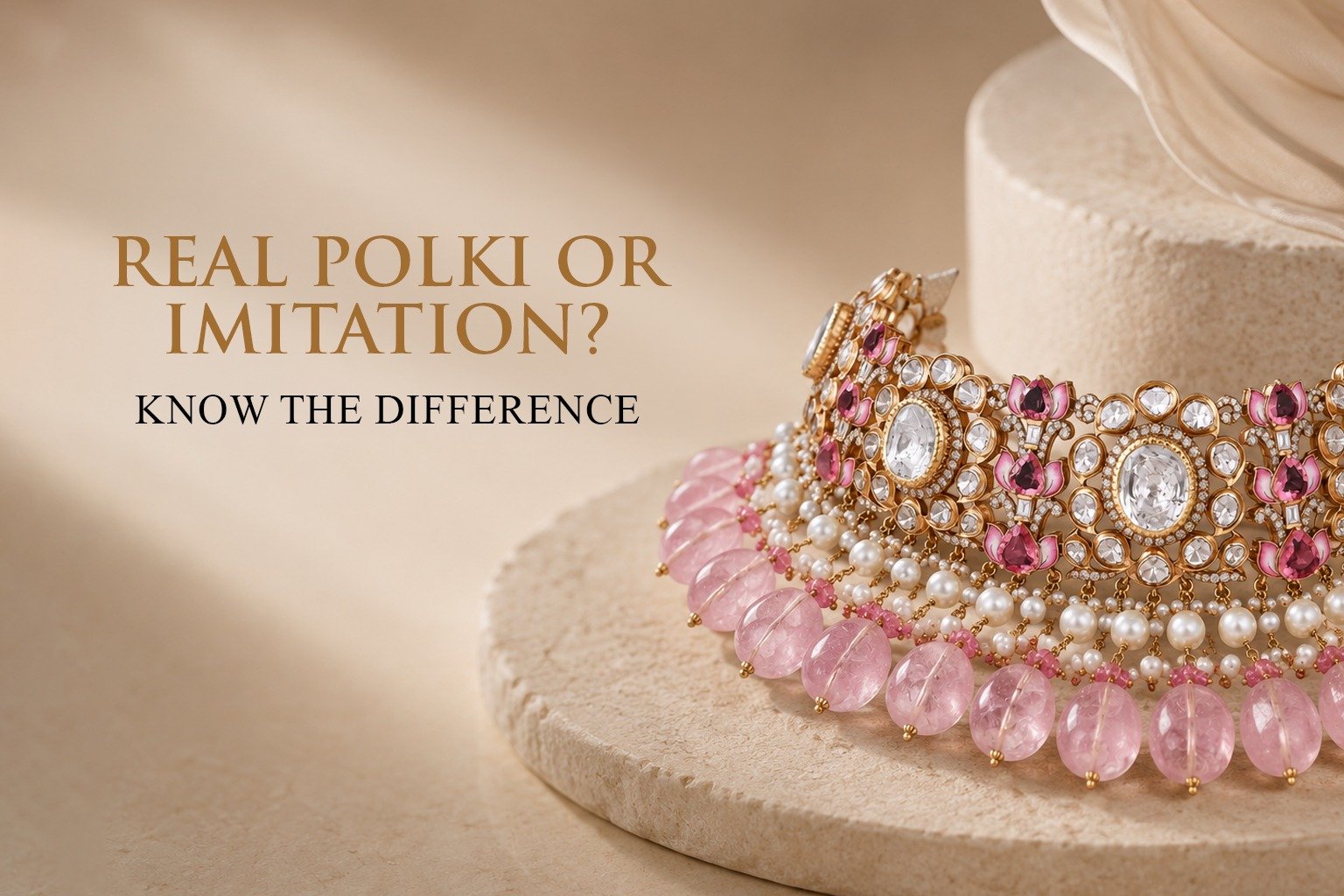
Real Polki jewellery is made from natural and uncut diamonds. This gives it that soft and slightly uneven glow that catches light differently from piece to piece. However, imitation Polki jewellery is typically made using glass, crystals or any other artificial stone materials, which replicate the look of real Polki without the material value. Before buying, it helps to check the stone appearance, shine, stone setting, backside finishing, weight, certification or billing, seller reputation and the price difference compared to similar pieces in the market.
Visual inspections can be helpful in detecting warning signs. But for expensive Polki jewellery, it is always advisable to ask for correct billing, materials and verification.
Why Jaipur is Trusted for Authentic Polki Jewellery
Jaipur has always been known for being one of India’s most renowned centres for traditional gemstone and Polki work. The city’s karigars have been working with uncut diamonds for generations. Families have passed down the craft for decades, refining techniques while still holding onto the traditional methods that make Polki what it is.
If you’re exploring jewellery manufacturers in Jaipur, you’ll notice most of them still rely on hands-on stone setting rather than machine work. That is partly why Jaipur-made Polki has such a strong reputation.
The artisans understand the natural irregularities of uncut diamonds instead of trying to smooth them out or hide them. Buying from established manufacturers in Jaipur provides a level of assurance that is harder to find when dealing with anonymous sellers for buyers unfamiliar with the craft.
What is Real Polki Jewellery?
Real Polki jewellery is built around natural uncut diamonds that have not gone through the faceting and polishing process used for regular-cut diamonds. Because these stones are left in their raw form, each one carries a slightly different shape, thickness and internal character. No two pieces ever look completely identical. It is one of the things that make Polki unique.
- Real Polki reflects light with a soft and warm glow instead of a sharp sparkle.
- Its natural and uncut surface creates a subtle shine that feels organic.
- It has a sophisticated look instead of being too shiny and artificial.
- This classic appearance makes Polki an ideal choice for bridal, festive and heritage jewellery.
Most authentic Polki pieces are still handcrafted by skilled artisans who set each stone individually, often backed with foil to enhance its natural brilliance. Discover the designs of Polki jewellery to understand what real Polki pieces generally look like in traditional, festive and wedding jewellery collections, and why their texture cannot be replicated by machines.
What is Imitation Polki Jewellery?
Imitation Polki is created to visually resemble real Polki without using natural uncut diamonds. Depending on the manufacturer, these pieces may use glass, crystal, plastic or other synthetic stones cut and set to imitate the raw look of genuine Polki.
Because the materials cost far less, imitation Polki is priced significantly lower than the real one. Many pieces are genuinely attractive and well made for what they are, but they simply do not carry the same material worth or long-term value as jewellery set with natural stones.
There is nothing inherently wrong with imitation Polki when it is sold honestly as a fashion or artificial piece. Problems only arise when imitation jewellery is deliberately passed off as real Polki to unsuspecting buyers, often at prices that suggest authenticity, which the piece does not actually have.
Real Polki Jewellery vs Imitation Polki: Quick Comparison Table
|
|
|
|
|
|
|
|
|
|
|
|
|
|
|
|
|
|
|
|
|
|
|
|
|
|
|
|
|
|
|
|
|
|
|
|
How To Identify Real Polki Jewellery Before Buying
Polki jewellery carries timeless charm. But not every sparkling piece is genuine. Knowing what sets authentic Polki apart helps you shop with confidence, protect your investment and appreciate true craftsmanship.
Check the Stone Appearance
Real Polki stones are never perfectly uniform. Look closely at the individual stones on a piece. If every single one appears identical in shape, size and clarity, that is often a sign of synthetic or machine-cut material rather than natural uncut diamonds.
Genuine Polki embraces small imperfections, and this irregularity is actually a mark of authenticity rather than a flaw.
Look at the Shine
Natural uncut diamonds reflect light in a soft, muted way. The glow feels gentle and slightly inconsistent across the piece. Imitation stones, particularly glass or crystal, tend to throw off a sharper, glassier shine that can look almost too perfect under normal lighting.
If a piece sparkles aggressively the moment it catches light, it is worth asking more questions about the stone type.
Observe the Stone Setting
Real Polki is traditionally set using a technique where stones are held in place with fine gold or metal claws, often backed with foil to boost brilliance. The setting should feel secure and intentional. The stones are properly set rather than just glued on top.
Sometimes adhesive is used in imitation jewellery for a quicker setting process. This can make it look like they are slightly raised or pasted on, rather than part of the design.
Check the Backside Finishing
The reverse side of a jewellery piece often reveals more than the front. Authentic Polki jewellery usually has neat enamel work, called meenakari or clean metal finishing on the back, reflecting the same care given to the visible side.
Imitation pieces frequently cut corners here, leaving rough edges, visible glue marks or an unfinished appearance where the buyer is unlikely to look closely.
Ask for Billing, Material Details and Certification
A reliable seller will always be willing to provide a proper bill that states the materials used, including the type of stone and metal purity. For higher-value pieces, certification or documented material details adds another layer of assurance.
If a seller hesitates, avoids the question or refuses to put anything in writing, treat that as a significant warning sign.
Compare the Price Realistically
Real Polki jewellery, given the cost of natural uncut diamonds and skilled handwork, will always sit at a higher price point than imitation pieces. If a deal seems unusually cheap for what is being marketed as genuine Polki, it is reasonable to question whether the stones are actually natural.
Comparing prices from a few reliable sources can help you form realistic expectations prior to buying a piece.
Common Signs of Fake or Imitation Polki Jewellery
Always be aware of the following red flags while considering a particular piece of jewellery:
- Stones look too shiny or glass-like.
- All stones appear exactly the same in shape and size.
- The price is unusually low for what is claimed to be real Polki.
- Seller avoids giving clear material details.
- No proper bill is provided.
- Stones lack the soft clarity typical of natural uncut diamonds.
- The backside finishing looks rough or incomplete.
- Stones appear pasted rather than properly set.
- Design looks mass-produced with no handcrafted detailing.
- The piece feels too light for its claimed material value.
- No after-sales support is offered.
- The seller cannot clearly explain whether the piece is real or an imitation Polki.
Why Craftsmanship Matters in Real Polki Jewellery
Authenticity is not only about the stones. It is also about the way a piece is designed, set and finished, which plays just as big a role in its overall quality. Skilled craftsmanship pulls together several stages, from stone selection and design balance to the metal framework, stone setting, polishing, finishing and the detailing on the back.
Each of these steps requires real experience. It shows when any stage gets rushed. A well-crafted piece feels balanced when you hold it, remains comfortable when worn and holds up over years of use. On the other hand, a poorly made one may become loose, discoloured or lose its gems much faster than expected.
In order to understand how workmanship determines quality, potential buyers need to have information about the jewellery-making process, such as design, setting of stones, polishing, finishing and quality control. All of these directly influence how a finished Polki piece looks and performs over time.
Real Polki Jewellery Buying Checklist
Before finalising a purchase, it helps to run through a simple checklist:
- Is the seller clearly stating that the piece is real Polki?
- Are the stones confirmed to be natural uncut diamonds?
- Does the shine look soft and natural rather than overly glossy?
- Are the stones slightly varied instead of perfectly identical?
- Is the setting neat, secure and free from visible glue?
- Is the backside finishing clean and detailed?
- Is the piece comfortable and balanced when worn?
- Does the pricing feel realistic for genuine Polki?
- Is a proper bill being provided with the purchase?
- Are stone and metal details clearly mentioned on the bill?
- Is the seller or manufacturer well-established and reputed?
- Is after-sales support, such as repairs or resizing, available?
Going through these points before buying can save a lot of second-guessing later and give buyers a clear, structured way to evaluate any piece they are considering.
Conclusion
Real Polki jewellery is built on natural uncut diamonds, carrying a soft, raw and handcrafted character that develops through skilled artisan work. Imitation Polki may share a similar visual style, but it typically relies on substitute stones and offers far less material value in return. Before making a purchase, buyers should carefully check the stone appearance, shine, setting, backside finishing, certification, pricing and the trustworthiness of the seller.
For handcrafted Polki jewellery and traditional jewellery collections, reach out to Shivam Jewels and Arts.
FAQs
How can I identify real Polki jewellery?
Look for natural uncut diamonds with a soft, uneven glow, slightly irregular shapes, a secure setting and clean backside finishing. A genuine seller will also give you proper billing and material details without hesitation.
What is imitation Polki jewellery?
The jewellery is designed to replicate Polki but is instead made from artificial substances such as glass or crystal stones rather than natural uncut diamonds. It costs much less than real Polki.
Does real Polki jewellery shine like diamonds?
Not really. The sparkle of Polki is softer and less intense than the sparkling polish of diamonds. It feels raw and natural rather than sharp and shiny.
Is imitation Polki bad?
Not at all, as long as it is sold honestly as a fashion piece. The problem only comes up when it is misrepresented as genuine Polki at a price that suggests authenticity, which it does not have.
Why is real Polki jewellery expensive?
The price reflects the cost of natural uncut diamonds along with the time and skill needed to set and finish each piece by hand, something synthetic materials simply can’t replicate at the same cost.




 Chat with us !