


Blog Details
How to Find Reliable Jewellery Suppliers in India
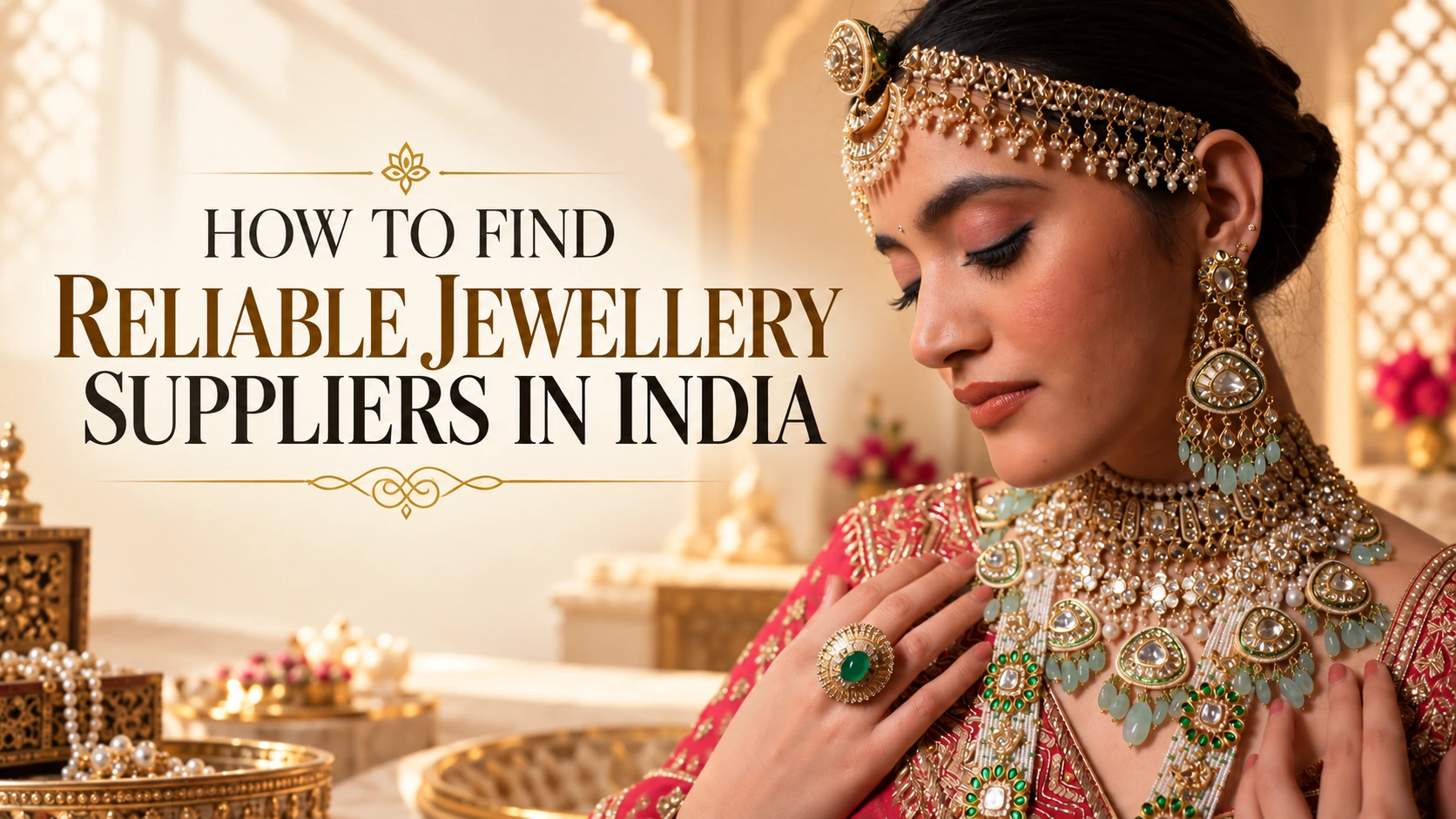
Finding a jewellery supplier is the easy part. A quick search, a few WhatsApp chats and a catalogue are all it takes. The hard part is finding reliable jewellery suppliers, the ones who give you the same quality, the same rate and the same dispatch time on the tenth order as they did on the first.
One wrong supplier costs you more than one bad order. Uneven finishing means returns. A late consignment can mean a missed wedding season. And a supplier who goes quiet when you ask for replacements leaves your money stuck in stock you can't sell.
You also don't have to rely on a supplier's website or their word alone. A few simple checks, which we'll go through below, will show you quickly whether a manufacturer or wholesaler is right for your business.
What Makes a Jewellery Supplier Reliable?
A reliable jewellery supplier consistently delivers the agreed product quality, communicates clearly, offers transparent pricing and terms, and fulfils orders as promised, including repeat and bulk orders. Reliability shows up over time, not in a single good sample.
In practice, that means five things:
- Consistent quality from one batch to the next
- Clear pricing, MOQ and payment terms
- Prompt, honest communication
- Capacity to handle your order size
- A defined process for dispatch, delivery and returns
Most buyers focus on the first point and ignore the rest. A supplier with beautiful samples but vague terms and slow replies will still cost you money.
How to Find Reliable Jewellery Suppliers in India
You can find suppliers through trade referrals, jewellery trade fairs, wholesale markets, manufacturer websites and business directories. Finding names is the easy part. The real work is judging them on the factors below.
Check Product Quality and Consistency
Ask for samples, but treat them as a starting point. A sample is the supplier's best work. What you need to know is whether the 500th piece matches it.
Look closely at:
- Finish and polish: rough edges, uneven plating or visible solder marks
- Stone setting: loose stones, uneven alignment or gaps
- Clasps and fittings: weak hooks, stiff locks or thin findings
- Weight and dimensions: whether pieces match the stated specifications
- Colour match: especially in gold-tone or oxidised finishes
If you plan to reorder, place a small trial order first, then reorder and compare the two batches. Consistency across batches is the clearest sign of a dependable supplier.
For gold jewellery, ask about hallmarking. Mandatory BIS hallmarking applies to gold jewellery in notified districts. The government's sixth phase, in force from 2 March 2026, covers 380 districts, and the mandate applies to 14, 18, 20, 22, 23 and 24 karat gold. Buyers can check a hallmarked piece's HUID using the Verify HUID feature in the BIS CARE app. Rules and district coverage keep expanding, so confirm the current position on the official BIS website or through the All India Radio report on the sixth phase, and ask your supplier how they handle compliance.
Evaluate Manufacturing Capability
Work out whether you are dealing with a manufacturer, a wholesaler who buys from others, or a trader. None of these is automatically bad, but each has different strengths. A manufacturer can usually discuss designs, production timelines and modifications directly. A trader may offer a wider range but less control over quality.
Useful questions include:
- Do you manufacture in-house, or outsource some processes?
- How long does a typical bulk order take?
- Can you repeat a design in the same quality after a few months?
- How do you check quality before dispatch?
A genuine manufacturer answers these without hesitation. If the answers stay vague, treat that as information.
Compare Wholesale Pricing and MOQ
MOQ stands for minimum order quantity: the smallest number of pieces or the smallest order value a supplier will accept. Wholesale jewellery MOQ may be set per design, per category or across the whole order, so ask which one applies.
The cheapest quote is often cheap for a reason: thinner plating, lighter weight, weaker finishing or hidden charges. A slightly higher price from a supplier who delivers consistently usually works out cheaper once returns and unhappy customers are counted.
Check Communication and Responsiveness
Pay attention to how a supplier behaves before you have paid them anything. Do they answer specific questions or send a generic brochure? Do they reply within a reasonable time? Do they tell you when a design is unavailable instead of agreeing to everything?
Good suppliers set realistic expectations. A promise of "everything possible, any quantity, any deadline" usually means the problems will come later.
Ask About Customisation and Bulk Orders
If you run a boutique or your own brand, chances are you will want something a little different: a custom design, a particular finish, or your own packaging. Bring this up in the first conversation. Find out whether the supplier takes custom work at all, what minimum quantity they need for it, and how long sampling usually takes. Some suppliers say yes to everything on the phone and then take weeks to send a sample.
Review Packaging, Dispatch and Delivery
A well-made piece can still reach you scratched or bent if it is packed in a hurry. Ask how the pieces are packed and whether each one is protected separately. Also find out how the parcel is insured and tracked, and who is responsible if it is damaged or lost on the way. It is much easier to settle this before the order than after.
Get the dispatch timeline in writing as well, not just a "will send soon". This matters most before wedding and festival seasons. If stock reaches you a week late, you have already lost sales that don't come back.
How to Verify a Jewellery Supplier Before Placing a Bulk Order
To verify a jewellery supplier, check that the business is genuine, look at the actual products rather than just photos, speak to a past buyer if possible, and place a small trial order before you commit to bulk. Here is how that works in practice:
- Check the business details. Get the registered name, address and GST number, and see that they match on the documents and the website. If the address or the name keeps changing, be careful.
- See how they appear online. A proper website, an active business profile and a real address are all good signs. A weak online presence doesn't prove anything is wrong, but it does mean you should check a little more.
- Ask for proper samples. Catalogue photos are always the best-case version. Ask for videos in natural light, or get a few samples sent by post.
- Talk to someone who has bought from them. If the supplier is happy to connect you with one or two retail customers, a short call can tell you more than the sales pitch.
- Visit if you can. Seeing the workshop or showroom shows you how they actually work. A brochure can't do that.
- Start with a small order. Treat it as a test: look at the quality, the packing and whether it arrives on time.
- Keep the terms in writing. Price, MOQ, payment schedule, delivery date and what happens with defective pieces should all be written down, even if it's only in an email.
A good supplier will not mind any of this. If someone avoids these checks or gets irritated by them, you will have learned that before any money has gone out.
Red Flags to Watch for When Choosing a Jewellery Supplier
Some warning signs show up early:
- Prices far below the market with no explanation
- No physical address or business details, or details that change between conversations
- Pressure to pay quickly before samples or terms are clear
- Refusal to send samples or to give videos on request
- Vague answers on MOQ, delivery time or returns
- Catalogue photos that look edited or copied from other sources
- Claims that cannot be checked, such as "the biggest" or "number one"
- No clarity on hallmarking for gold products
One red flag is a reason to ask more questions. Several together are a reason to walk away.
Why Consider a Jaipur Jewellery Manufacturer?
Many buyers look at Jaipur when sourcing jewellery. There are jewellery manufacturers in Jaipur and wholesale suppliers serving retailers elsewhere in India, and the city is easy to visit for buyers who want to see samples and production first-hand.
The practical benefit is access. Buying from a manufacturer or wholesaler in one location lets you compare designs, discuss customisation and inspect quality in person. Still, a city's reputation does not guarantee any single supplier's quality. Apply the same checks to a Jaipur supplier as you would to one anywhere else.
Questions to Ask a Jewellery Supplier Before Ordering
Keep this list handy when you speak to a new supplier:
- Are you a manufacturer, wholesaler or trader?
- What is your MOQ, and does it apply per design or per order?
- Can I see samples, and what do they cost?
- How do you keep quality consistent across large batches?
- What is the typical production and dispatch time?
- Do you offer customisation, and what are the minimums?
- How is hallmarking handled for gold products?
- How do you pack and ship orders?
- What happens if I receive defective or damaged pieces?
- What are your payment terms?
Note how the supplier answers as well as what they say. Clear, specific answers point to a supplier who runs an organised operation.
FAQs
How do I find reliable jewellery suppliers in India?
Trade referrals, jewellery fairs, wholesale markets and manufacturer websites are the usual starting points. Shortlist three or four suppliers, ask each for samples and rates, and see who answers clearly and on time. Before a big order, check their business details and try a small trial order first.
What should I check before choosing a jewellery supplier?
Look at the finish and quality of the samples, then ask about MOQ, payment terms and how long dispatch takes. Find out whether they can repeat the same quality in larger batches. For gold jewellery, ask how they handle BIS hallmarking. Get everything in writing before you pay anything.
How can I verify a jewellery manufacturer?
Start with the basics: the registered business name, address and GST details should match everywhere they appear. Then talk to a buyer who has already ordered from them, if the supplier is open to that. If you can, visit the workshop. Nothing tests a supplier better than a small first order.
What is MOQ in wholesale jewellery?
MOQ means minimum order quantity, the smallest order a supplier will accept. Some count it in pieces, some in order value, and some apply it to each design separately. Ask which one your supplier uses, because it decides how much stock you need to buy and how much money gets blocked in it.
Is Jaipur a good place to source wholesale jewellery?
It can work well, especially if you want to see samples, meet the manufacturer and discuss custom designs face to face. Jaipur has many manufacturers and wholesalers supplying buyers across India. But quality still depends on the individual supplier, so judge each one on their own work, not on the city.
How can I compare jewellery suppliers before a bulk order?
Ask every supplier the same set of questions, so the answers are easy to put side by side: price per piece, MOQ, payment terms, delivery time and what happens if pieces arrive damaged. Then order a small trial lot from your top pick. The lowest price is not always the best deal.
Conclusion
There is no shortcut to finding reliable jewellery suppliers. One good sample proves very little. What tells you more is how the supplier performs over several orders: whether the quality stays the same, whether the terms stay clear, and whether they pick up the phone when something goes wrong.
So spend a little time on checks before your first bulk order. It costs far less than sorting out a bad consignment later.
If you are comparing jewellery suppliers in India, Jaipur-based manufacturers such as Shivam Jewels & Arts LLP are also worth a look for wholesale jewellery and bulk requirements. Whoever you choose, begin with a small order, keep the terms in writing, and increase quantities only after you are happy with the first batch.




 Chat with us !