Temple Jewellery Manufacturers in India: What We'd Tell a Jeweller Before They Buy
Published
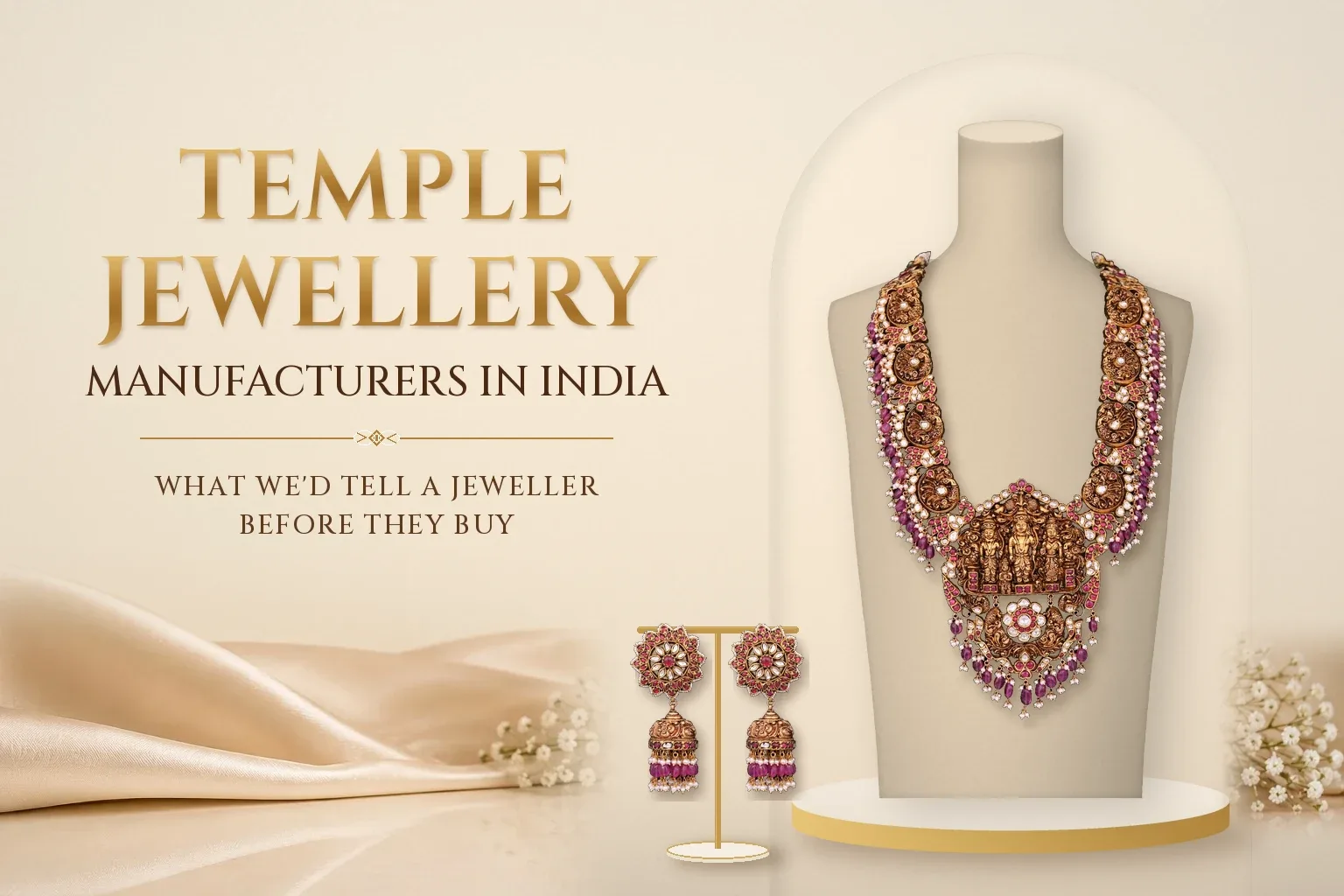
Send the same Lakshmi haram photo to a few temple jewellery manufacturers and the quotes can come back far apart. Most of that gap has little to do with the design. It comes down to what the piece is made of, how it was made and what it weighs.
Temple jewellery manufacturers in India make gold, silver and gold-plated ornaments based on South Indian temple art: harams, chokers, jhumkas, vankis, waist belts and pendants with deity motifs. The traditional centres are in Tamil Nadu, Kerala and Karnataka, and manufacturers in Jaipur and Mumbai now supply temple designs to jewellers across the country.
We are one of those Jaipur manufacturers. Our family started in 1995 as a supplier to well-known jewellery brands, making pieces that went out under other people's names. We started Shivam Jewellers in 2009, showed at the Jaipur Jewellery Show for the first time in 2011, and became Shivam Jewels and Arts LLP in 2017. This guide is what we would tell any jeweller sourcing temple jewellery, including the questions you should ask us.
What do temple jewellery manufacturers in India make?
The name goes back to the ornaments made for deities in South Indian temples. The designs still borrow from temple walls and mythology: Lakshmi, Ganesha, peacocks, lotuses, elephants and small deity panels. If you want the history and styling, our post on what temple jewellery is covers it. This one stays with buying.
Most manufacturers work across some or all of these pieces:
- Chokers, short necklaces and long harams, often with coin or Lakshmi pendants
- Long sets with deity panels, such as Ram Darbar or Lakshmi designs
- Jhumkas, chandbalis and ear chains
- Temple-style mangalsutras and thali chains
- Vanki (armlets) and oddiyanam or vaddanam (waist belts)
- Maang tikka, nethi chutti and matha patti
- Pendants with a single deity, such as Balaji or Lakshmi
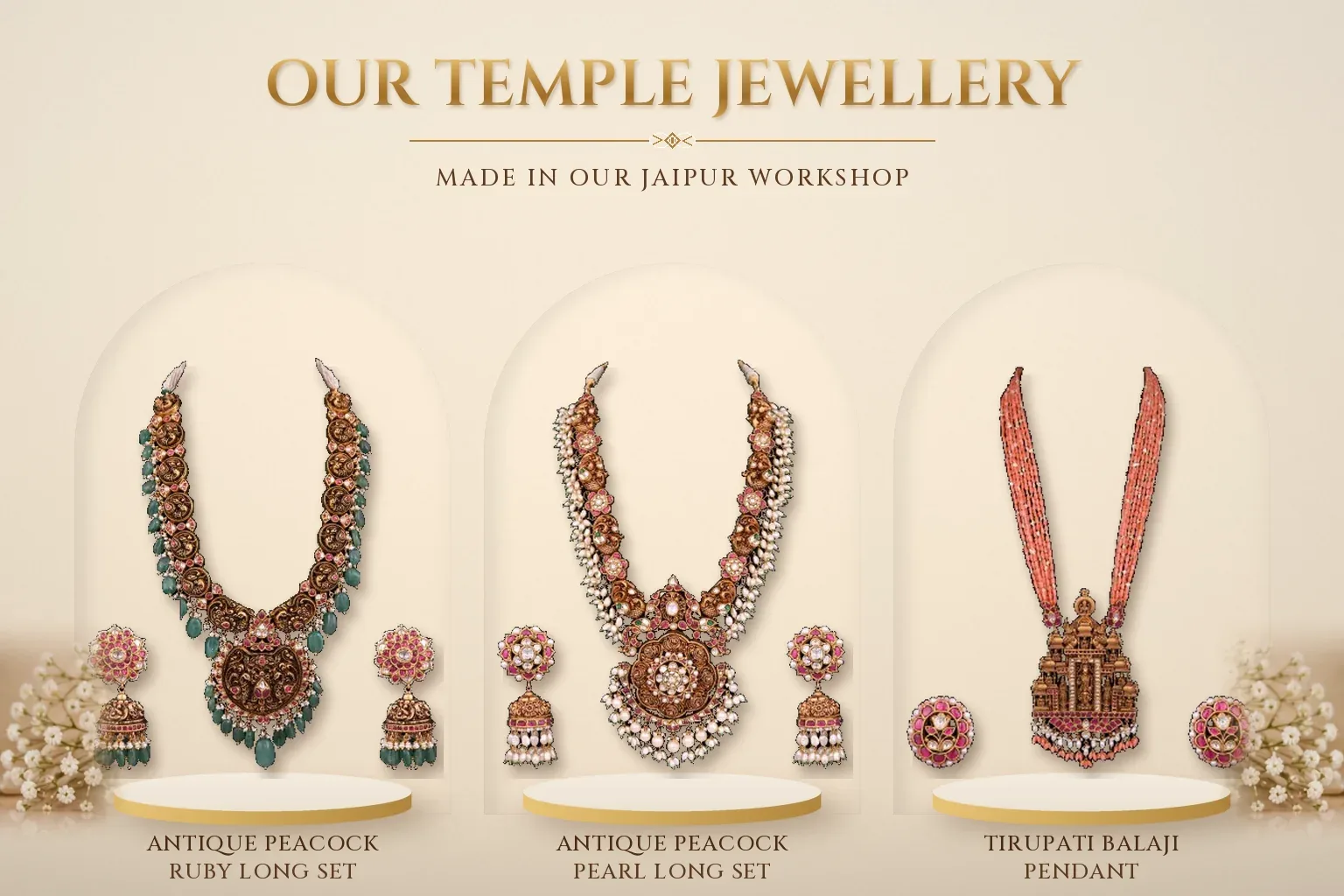
Our own temple jewellery collection is built around long sets, pendants and mangalsutras. It includes the Ram Darbar Temple Long Set with Rama, Sita and Lakshman, three peacock long sets (plain, ruby and pearl), and the Tirupati Balaji Pendant.
Where are temple jewellery manufacturers based?
We'll be straight about this. Temple jewellery is a South Indian craft, and the south has the deepest roots. Nagercoil, in Tamil Nadu's Kanniyakumari district, is the best-known name. Its craft is registered as a Geographical Indication, "Temple Jewellery of Nagercoil", in India's GI registry (IP India). Workshops there are known for filigree wirework, repoussé detailing and setting every stone by hand (GJEPC Solitaire).
Kerala, Karnataka, Andhra Pradesh and Telangana have their own temple and nakshi traditions and serve their own bridal markets. Mumbai and Gujarat have large gold jewellery factories that make temple designs in volume, including lighter versions.
Jaipur is different again. The city is known for Kundan, Jadau Polki, Meenakari and gemstone work, and Jaipur workshops like ours bring that handwork into temple designs. If your customers are South Indian brides who want a set exactly as their grandmother wore it, a southern maker may suit you best. If you sell in Delhi, Rajasthan, Gujarat or Mumbai and want temple motifs with antique finishes and gemstone work, a Jaipur maker is worth a look.
Gold, silver or plated: ask this first
Before you compare a single design, find out what it is made of. "Temple jewellery" covers everything from a 22K bridal haram to a gold-plated brass dance set, and those two belong to completely different customers.
| Material | What it is | Who buys it | What to check |
| 22K gold (916) | Solid gold, the usual choice for traditional bridal pieces | Brides and families buying heirlooms | BIS hallmark with HUID, weight per piece, stone weight |
| 92.5 silver with gold plating | Sterling silver base with a gold finish | Mid-price festive buyers | Silver purity, plating thickness, how long the finish lasts |
| Brass or copper with gold plating | Imitation pieces made to look like gold | Fashion, dance and budget buyers | Plating quality, stone quality, skin-safe metal |
22K suits temple pieces because the colour is warm and the metal is soft enough for deep, raised carving. Some studded or lighter pieces are made in 18K for strength. Whatever the karat, ask for it in writing on the quote.
You will also find plated temple sets online at very low prices. That is a separate market with its own suppliers, so shortlist manufacturers who make the material you actually sell.
Why two similar pieces get very different quotes
A photo can't tell you how a piece was made, and the method changes the price more than most buyers expect. Most temple jewellery comes from one of three methods.
Handcrafted nakshi work
Nakshi is a technique, not a style. The karigar raises and carves the design out of the metal so it has real depth, almost like a small sculpture. Temple describes how the piece looks; nakshi is one way of making it. It takes longer and the making charges are higher, but this is the depth bridal buyers notice.
Casting
Molten metal is poured into moulds taken from a master design, and the piece is then finished and set by hand. Casting keeps repeat orders consistent and making charges lower, so many bestsellers are made this way.
Electroforming
Some manufacturers use electroforming for plain gold temple jewellery. Gold is deposited onto a mould to make hollow but strong pieces (Indian Jeweller). You get a big, bold piece at a lower gold weight.
When two quotes for a similar haram are far apart, ask both suppliers which of these methods they used. That usually explains a large part of the gap.
What jewellers in different regions buy
Temple jewellery doesn't sell the same way everywhere. Even earring size changes from one region to another.
- Manufacturers have reported that North Indian buyers prefer bigger temple earrings, while South Indian buyers lean towards smaller ones (Retail Jeweller India).
- A maker of lightweight temple jewellery told GJEPC's Solitaire magazine about strong demand in Maharashtra and Gujarat (GJEPC Solitaire).
- North Indian and fusion brides now wear temple pieces for pre-wedding functions, and some for the main ceremony. Our guide to bridal jewellery trends for this wedding season shows where temple pieces fit in.
- South Indian bridal buyers still want the full traditional set, with vanki, oddiyanam and a long haram.
If you sell in more than one region, ask for two versions of your bestsellers, a classic weight and a lighter one.
How we make temple jewellery in our Jaipur workshop
Everything in our temple range is made in-house at our workshop on Gopalpura Bypass Road, from the first design drawing to the final finish. Our four partners, Rakesh, Saurabh, Shivam and Sahil Soni, run the business, and Sahil looks after artisan production.
A few things about how we work that buyers usually ask about:
- Finishes. Our long necklaces come in matte gold, antique gold or reddish antique finishes. Mangalsutras come in darker matte, antique or reddish antique tones.
- Motifs. Lakshmi, Ganesha and peacocks appear most often, along with deity panels like Ram Darbar and Balaji.
- Stones. The Antique Peacock Ruby Long Set uses real rubies, and we don't use artificial stones in our temple pieces.
- Handwork. Carving and clasp work are done by hand.
- Customisation. We can change stones, colours and weight on existing designs. Send us a photo or an idea and we can make pendants, motifs and chains to match.
- Private label. We make private-label mangalsutras with your branding, logo engraving and packaging.
On order size, we take everything from small first orders to large wholesale runs, whether that's 10 necklaces or 1,000 mangalsutras. Most orders ship in 15 to 30 days, depending on quantity and how much customisation is involved. We deliver across India and ship overseas in safe, insured packaging.
One customer review on our site put it better than we could: they liked "the perfect blend of antique and South Indian-inspired designs" in the piece they bought for a wedding. That mix of antique finish and South Indian design is what our temple range is built around.
How to choose a temple jewellery manufacturer
The usual rules for picking any supplier apply, and our post on choosing a jewellery manufacturer goes through them. For temple jewellery, these are the things we'd look at first:
- Look at the deity faces on a real piece, not only in a photo. Faces and proportions are where poor finishing shows first, and your customers will notice.
- Check that the making method matches the look and price you need.
- Ask which finishes they offer and how each one wears over time.
- Find out which stones are used and how securely they're set.
- For gold, make sure every piece carries a BIS hallmark with an HUID.
- See whether they make enough of the range to give you matching sets.
- Confirm that repeat orders will match the approved sample in weight, finish and detail.
Visit the workshop if you can. If you can't, ask for photos or videos of pieces being made, and place a small sample order before a big one. Any manufacturer worth working with, us included, should be happy with that.
Questions to ask before you place an order
Get answers to these in writing before you confirm:
- What is the metal and purity, and is every piece hallmarked with an HUID?
- What is the weight tolerance per piece, and how are stones weighed and charged?
- Which production method is used for this design?
- Can you send a physical sample before the bulk order?
- What is the minimum order quantity (MOQ) per design?
- What is the production and dispatch time, including during wedding season?
- Which finishes are available, and how should they be cared for?
- What is your policy on repairs, replacements and exchanges?
- How is the order packed and insured for dispatch?
On the first question: gold hallmarking is mandatory in districts notified by the Bureau of Indian Standards. A hallmarked piece carries the BIS mark, a purity mark and a six-digit HUID, and anyone can check the HUID on the BIS CARE app (News On Air).
If you want your own designs made from scratch, our guide to custom jewellery manufacturing in India explains the design, sample and production stages. For ready designs in volume, read how to order wholesale jewellery from Jaipur.
Choosing among temple jewellery manufacturers in India
Start with your customer, not with a supplier list. Decide whether you're buying classic South Indian bridal sets, lighter festive pieces or temple motifs for North and West Indian brides. The metal, the making method and the right manufacturer all follow from that.
Then ask for the hallmark, a sample and written terms before a large order. If you'd like to see what a Jaipur temple range looks like, browse our temple jewellery collection or message us on WhatsApp with the designs you're considering. We'll send prices and availability.